Archive for category DIY
Take the Floor
Posted by Adam A. Ries in DIY, Home Improvement on June 2, 2014
It took some time, but the bathroom now has an OSB floor! Or it did, but now you can’t see it because I’m back to tearing off the plaster & lathe walls. This photo shows just one small piece of the floor remaining to be screwed into place.

But the subfloor was not as easy as it sounds. I couldn’t just drop the OSB boards down and start screwing it into place. I tested it with the first piece, and found that the board rocked on one end, and dipped in the middle when I stood on it. That was an indicator that the floor joists were not all the same height. I used masonry string (basically a bright color thin cord) and a string level, and stretched the string from one corner of the room to the other. I simply wrapped the string around the head of a nail and then hammered the nail all the way into the top of the floor joist. Then pulled it to the opposite corner of the room, stretched the string tight, and nailed it into place again. Using the string level, this showed me how the string was touching the floor joists on the edges of the room and made a level line, but the string did not touch the joists in the center of the bathroom.
Why? Well, I’m no structural engineer but I would say from the weight of a 300 # cast iron tub, and the years (and years) of water leaks probably had something to do with it. The joists are very sturdy, but they’ve sagged over the last 98 years from weight and water penetration through the old floor. So how to fix this.
I knew I couldn’t raise the floor joists, so I measured the distance between the sunken joist and the string, and ripped long shims on my table saw from a 2×4. In the center of the room, I needed a shim 5/8″ thick, and then one at 3/8″ for each joist on either side of the first. I laid them in place on each floor joist under the string, and now the string touched each one and was perfectly level. I nailed these shims into place with just a few nails each.
Then I carried the OSB floor back in and laid it down. Voila, it laid flat and level, no rocking and no dipping! Then I screwed it down with 2 1/2 deck screws along each of the floor joists, spacing the screws about 10″ apart. Why so close? I do not want any movement with this floor, as that will mean cracked tiles or grout down the road.
So now with a floor down, I started attacking the walls with a hammer, pry-bar, anything else I could swing the break the plaster off and then tear off the lathe boards. I couldn’t do this step before tearing up the original floor, because that floor was so rotted through it was unsafe to stand on.
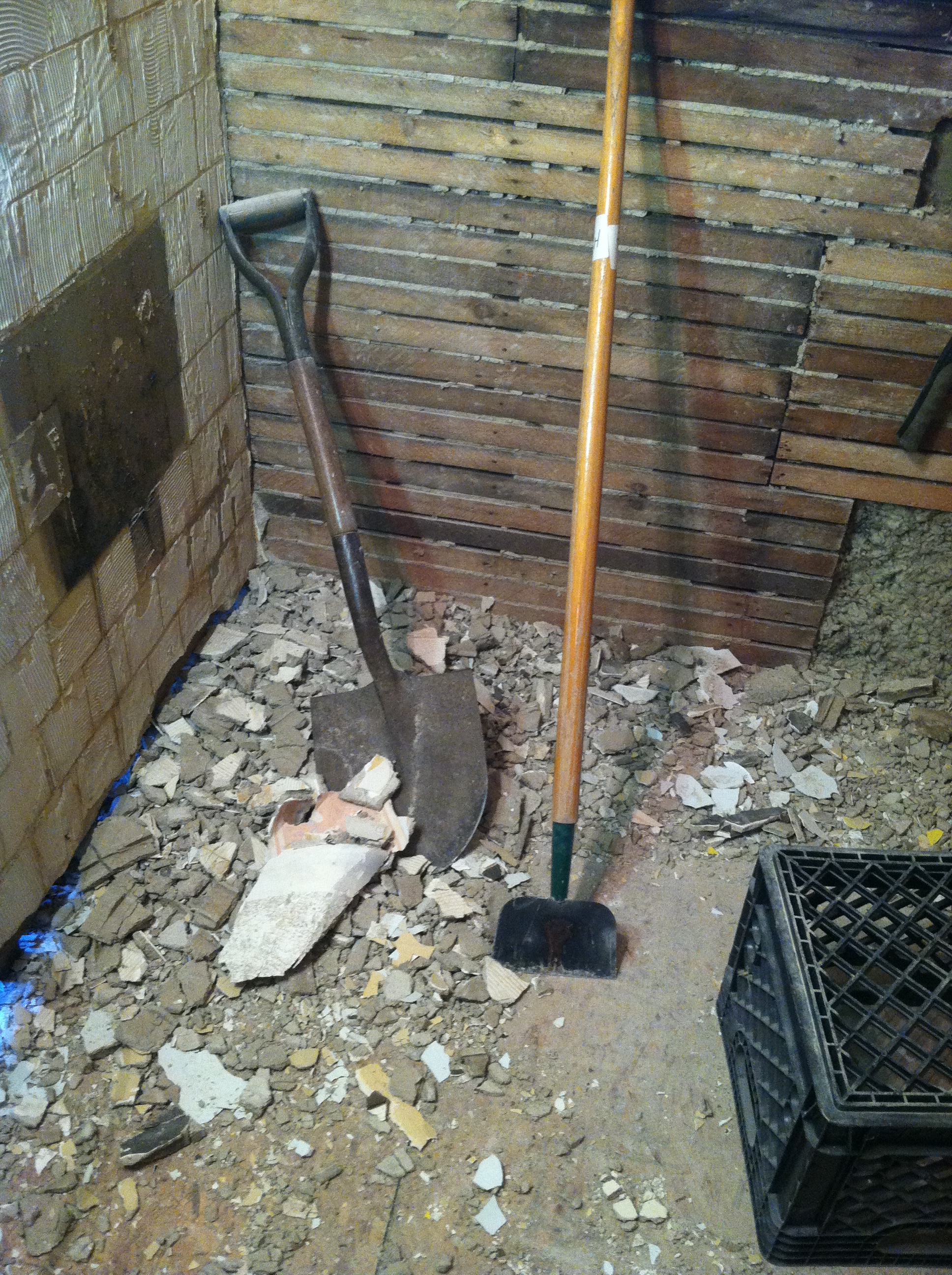
Plaster removal is slower and dirtier than I expected. It’s not as quick as Nicole Curtis makes it look. I’ve learned over the last 2 months that all of those fancy HGTV and DIY home improvement shows rely way too heavily on one of two things: time lapse video, and an unseen crew of 20 or more.
Getting Drained
Posted by Adam A. Ries in DIY, Interior Design on May 27, 2014
Not physically myself, no. In fact, I couldn’t be more excited to leave work each evening and throw on dingy clothes to continue playing home renovation. No, getting drained in the sense that any flowing water can now find its way safely out of the house. Which, as Martha would say, is a good thing.
I started with the kitchen sink, worked my way to the washer drain, and then to the existing soil stack. It already had an arm coming off from the old washer drain, so I made the connection between existing cast iron and new PVC pipe with a rubber flexible coupling (often called by the brand name Fernco). This was a pretty easy drain line. The kitchen sink will have a trap above the floor, so it meant installing a trap for the laundry drain, and then basically 2 straight stretches of pipe.
Then this past weekend I tackled the bathroom drains. The worst part was ambiguously cutting pipes and assembling fittings when I didn’t have exact measurements down in the crawlspace where I was working. I mean, I have the bathroom planned out down to the inch, but without a floor, its just a space between the rafters. But if I laid the floor down now, then it is twice as much work to squeeze in and out of the crawlspace from the outside. (I never realized how convenient it is to have a hole in your floor!) So I did rough measurements, then fine tuned them until everything lined up both above and below the floor. It feels so nice to have pipes glued and sticking up through the floor. I still need to finish the PVC drain vents running up into the wall cavity, connect the three individual vents (sink, toilet, and tub), and run the main vent up through the roof.
 Basically, this photo shows what I am trying to accomplish. The red highlighter shows the bathtub drain; the yellow is the toilet drain; the blue is the bathroom sink drain, and the purple is where the drains all connect and go to the sewer line. The green highlights the drain waste vents, which allow air into the pipes as the water drains out of each fixture. These vents prevent a vacuum when a sink or tub is draining, and eliminates slow draining tubs or gurgling noises when draining a full sink (tigers in the drain, as I’ve heard it called).
These vent lines should be easier, I think. The measurements don’t have to be perfect to align with a fixture, and they will be hidden inside the wall and then up through the roof. Then its subfloor time, how exciting!
From my research, everything I’ve read recommends a subfloor thickness of 1 1/4″ before laying tile. This is so the floor is strong enough not to flex and crack the finish tile or grout. And if I’m spending money on a nice tile floor, there will be no flexing going on. I decided on 3/4″ osb as the subfloor structure, and then 1/2″ cement backer board to to apply mortar and tile onto. The cement board is also very strong and sturdy, and will help support the floor but also give me a ready surface to lay down tile. The only down side is that the kitchen and bathroom floors will not be a smooth transition, but instead a 1/2″ higher on the bathroom floor. This is the minimum height allowable for most ADA floor transitions, so I think it will be rather unnoticeable with a nice transition piece.
Not yet floored
Posted by Adam A. Ries in DIY, Home Improvement, Interior Design on May 10, 2014
Finished the last of the plumbing supply lines today, but no, the bathroom still does not have a floor. Because I spent all morning loading and hauling 2 truck loads full of scrap metal and old pipes to the local metals recycling center. The new company that opened a few years ago is much more competitive on price than another local company, and they have much better customer service when I called to get metal prices over the phone. That better customer service was experienced in person, too.
All together there was galvanized steel duct, cast iron pipes, steel pipes, copper pipes, brass fittings, aluminum cans, steel cans, buckets of scrap metal (pulled nails, screws, other small parts & pieces), sheet aluminum, the old steel furnace housing, and the cast iron furnace heater.
Two trips and one small cut on the forearm later, I walked out with cash in hand. Not to shabby, considering half of what I scrapped in was just laying under the house. FREE. All I had to do was carry it out and load it onto a truck. In total, the cash I got was close to half of the amount I’ve invested in PEX hoses & fittings for the new supply lines. Nothing like tearing out old plumbing to pay for the new! (Whoa: imagine if every DIY project was like that… what you tore out would pay for half of the new project?)
Now it’s onto choosing and installing a water heater, but also installing the drain lines. The only portion that concerns me is the home’s original cast iron sewer drain. I’m not sure how to connect the new PVC drains into that, to end up with a leak-free drain that will last. So I need to make friends with a plumber and ask for help.
So now for a peak at the new bathroom layout!
Below is the original layout, with the tub and toilet so close together, sitting on the stool meant soaking your feet for a bath.

Here is how I am planning the new bathroom. I love Google SketchUp for quick floor-planning and 3-D modeling. Its quick to learn, but if you want to spend more time you can actually create a very detailed 3-D rendered model of a space or object. I literally drew out 12 different plans of how to move the 3 bath fixtures around in this space, and this naturally came out as the best solution.

You can see the door through the wall at the right, and the window above the tub on the left. Overall, I think this floor-plan of the bath feels so much more open. All the bathroom drains will be along one wall, which I hope will be easy to connect.
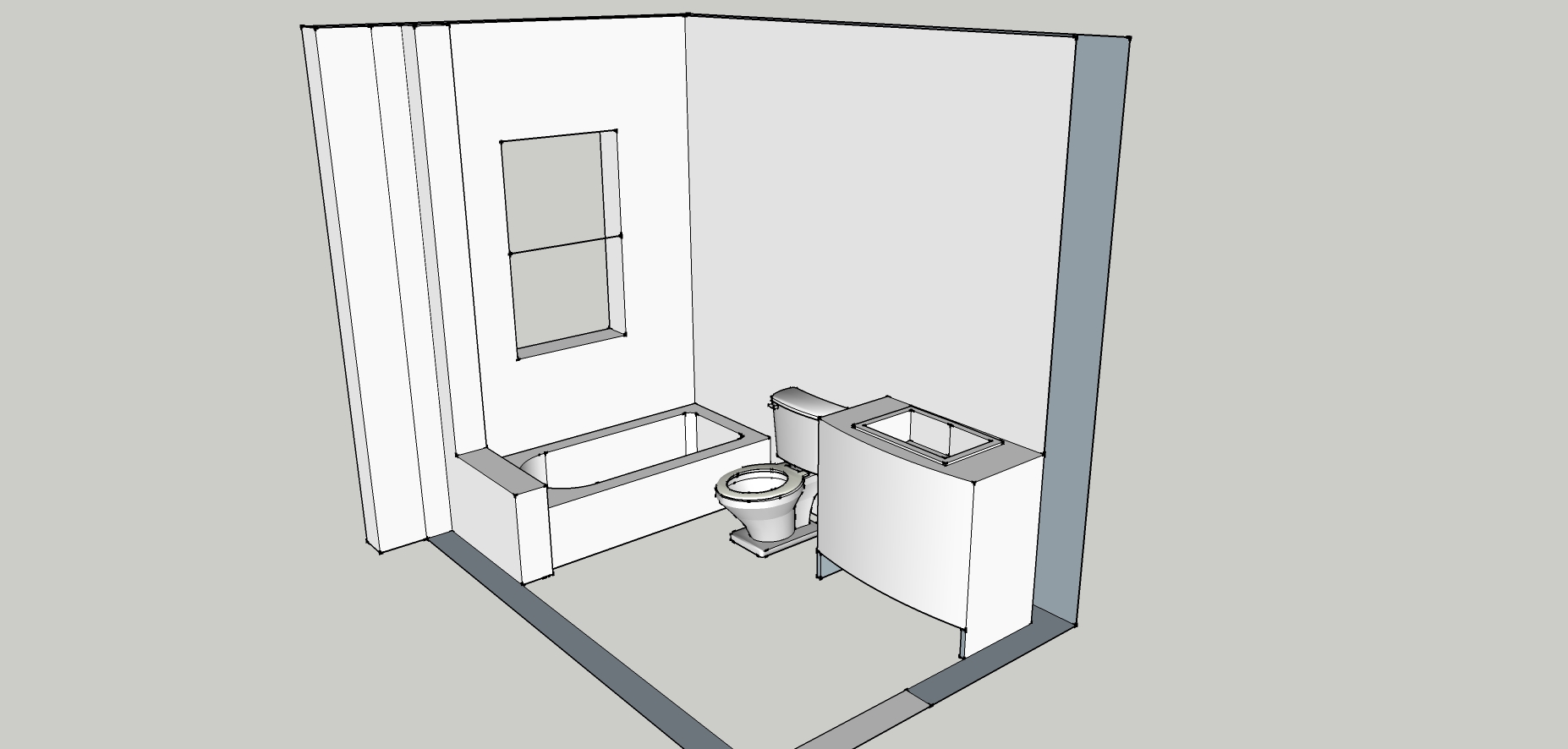
The bathroom is 68″ wide, and the tub is only 60″ long. This leaves a 8″ space between the tub and the finished wall. I tried several different versions of shelves, skinny cabinets, or other storage in this narrow nook, but decided on a knee wall to act as a ledge for bath bottles and such. The ledge doesn’t go directly to the window wall. Instead, there is a small chase to run the drain vent up though the ceiling and out the roof.
There will still be room on the wall opposite the toilet for a narrow storage cabinet if I need one. And although I didn’t show all the detail here, I am planning on a built-in mirrored medicine cabinet above the vanity, and another shallow in the wall to the right of the sink.
While drawing out this plan, I took some criticism for the idea of keeping the window. In this layout, the window will be in the shower area. I found several answers online on how to install a water-tight shower window, and they were all nearly the same. This instructional page & photo is what I will be following.
I just think natural daylight and ventilation is too important to close-in the window, no matter the room. Secondly, the window opens to the backyard, more than 50 feet from an alley, and another 50 feet to a neighboring house. If I really feel concerned about privacy, I can order the new window with opaque glass.
 Up and Adam [Ries]