Archive for category DIY
Give a House a Cookie — err, — Some New Plumbing
Posted by Adam A. Ries in DIY, Home Improvement on May 7, 2014
I’m quickly learning that there is no such thing as a small or contained project. A relevant example:
I’m in the midst of a bathroom renovation. One bathroom. But the way it keeps escalating reminds me of the well known children’s story, “If You Give a Mouse a Cookie.”
If you decide to gut a bathroom, you will probably decide to upgrade the plumbing.
If you need new plumbing in the bathroom, you should probably just replace the plumbing in the entire house.
While running new plumbing, you realize it’s the perfect time to replace the outdoor spigot and add a second spigot to the opposite side of the house.
When you want to run pipes to the kitchen, you realize the kitchen sink cabinet is actually metal, and the floor of this cabinet is nearly rusted away from years of leaking pipes. So if you are gonna re-plumb a house, you should probably tear out the deteriorating sink cabinet. Which means first lifting out the beautiful but extremely heavy cast iron sink.
And when you get to the laundry room with it’s somewhat “soft” floor, you should probably tear up the multiple layers of linoleum and punky plywood.
And once you have the bad flooring tore up, you realize that the original wood floor is too damaged to hold the weight and vibration of a full washing machine. So thats why if you are renovating a bathroom, you will probably need to replace the laundry room floor.
That is where the cute children’s story ends for tonight.
I finally have all of the old plumbing completely tore out, including the kitchen sink. I didn’t tear out all of these pipes right away, because it was kind of nice to use the old pipes as my straight line when running the new pex hose. The existing plumbing was a crazy labyrinth of galvanized, copper, pvc, and cast iron. And from how easily some of the connections came apart, I promise you it would have been leaking if the water was turned on.
For the new plumbing, I’ve got almost all of the new supply lines run. I now need to purchase a roll of red pex (for hot water) and run those lines to carry heated water to each of the shower, kitchen and bath sinks. The red and blue hose are entirely the same except color, but the color keeps things well organized.
I also need to make a decision on a new water heater. I’ve been researching tankless models, and I think I’ve decided on the ECO Smart brand. The prices are consistent with tank units, the reviews are good, and it seems very user intuitive. I can connect the water lines myself, but for the warranty to be valid, the electrical component must be wired by a licensed electrician.
And of course, supply lines are only half of a house’s plumbing. The other half is the drain pipes. The former mixed PVC, copper, and cast iron sections of drains had sections that had come unglued and weren’t sloped properly. Most of this I know how to do with new pvc, including traps and the correct pitch, and adding air vents for each the kitchen sink and washer drain. But the sewer stack that takes all the wastewater out of the house is the original cast iron. I’m not sure the best way to transition into this. So I’ll try asking friends for help, and if they don’t know, I wouldn’t be against hiring this part to make sure it is done perfectly correct, but it probably won’t be cheap.
Still gutting the bathroom
Posted by Adam A. Ries in DIY, Home Improvement on April 29, 2014
Well, following the last post, the bathroom looked like this:

By Sunday the entire wood floor was gone, as well as a little more of the plaster. So much for thinking I had knocked it all down. Now you can really see the mess in the crawlspace. And all of that mess needs to come out!

Because I know I will be doing some electrical work and need to maneuver all over for the plumbing, I want the crawlspace to be super easy to navigate and work in. No, it will never be on the cover of Better Homes & Garden magazine (I can see it now: “This Season’s Coolest Crawl Space”), but I don’t want it looking like a trash dump either. And apparently that’s exactly what a previous owner thought it was. Or was he hiding from the prohibitionists…
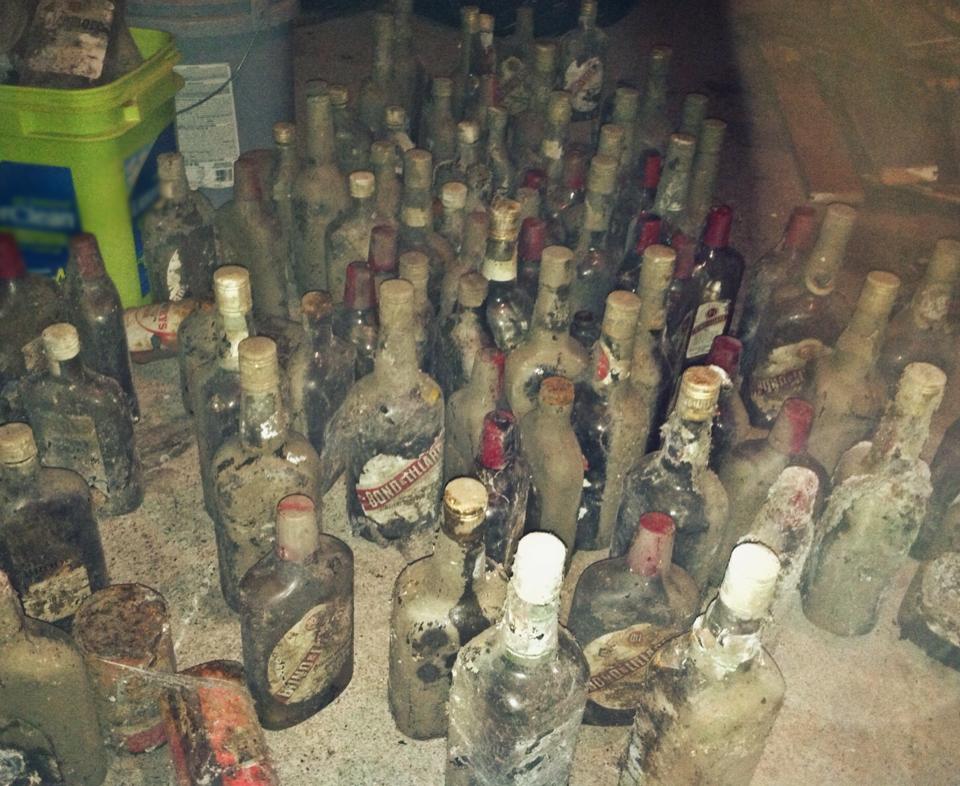
But seriously, that is most of the bottles I took out. Must be close to 100, almost all are Bond & Lillard whiskey, but along with buckets and buckets full of vintage beer cans (apparently not aluminum, because they are all but rusty pieces now – but I can tell he enjoyed Drewry’s), and a few other bottles of various sizes and proofs. I’m not tossing these all just yet, I see some future Pinterest projects down the road for the outdoor patio in my head.
The amount of crazy wiring under the bathroom floor had me concerned at first, but my contractor friend assured me it’s not uncommon. The amount this floor was leaking should have been a concern to the previous owner, but I plan to make sure the entire floor is watertight by using a waterproofing membrane before laying the tile finish floor. Upon heaving the 38th bucket of bottles and cans out of the crawlspace, I came to the conclusion that the previous owner MUST have been drinking whiskey while wiring. Most of the wiring is Romex, but it’s a crazy example of unorganized chaos – wires overlapping wires, hanging down between floor joists, wrapped around concrete support pillars, and not a straight line to be found. And was there a shortage of wire staples that year? Geesh! My OCD wants to tear it all out and start over, but I realize I cannot afford to do that and for the most part, its safe wiring, just confusing. I do plan to trace each wire to the corresponding room or piece of equipment, and then trace it to a breaker in the electrical panel. This is for two reasons; first, I want to know which breakers are responsible for which rooms/fixtures; second, I want to make sure there are not too many fixtures on one breaker. I’ve lived in a house where I might have on the tv, computer, and vacuum cleaner and then the heater kicks on and, click, the breaker trips. I’m gonna try to avoid that by calling in the the help of a friend who’s father is an electrician. And this book I picked up at a yard sale last fall. It might be vintage, but so is this house. And so much of the information in here still applies; the basics haven’t changed.

I also want the the trash out now because I need to begin running the new plumbing if I’m ever gonna get this bathroom finished. Even the nicest looking bathroom is no good without running and flushing water. And talk about metal scrap: the amount of galvanized metal, lengths of old copper, and cast iron is just stupid. And even the entire old steel furnace, which is a hulking piece of steel and cast iron (not used for what looks like decades). I’ll be keeping it all in a pile in the garage, and then hauling it to our local cash-for-scrap recycling center. I love when Earth friendly puts cash in the bank! But these steps aren’t so glamorous, and for fear of the dust in the camera, I probably won’t snap many photos of the trashing and plumbing steps. I do think it’s about time for a photo walk through of the entire house, to document the true “before” status.
Gutting the Bathroom
Posted by Adam A. Ries in DIY, Home Improvement, Interior Design on April 14, 2014
In a 1 bathroom house, it is no surprise the bathroom is about the number 1 priority before I can officially move in, especially since I knew it needed some major remodeling. Just from a simple peek into the bath cabinet, I had pretty much already made up my mind that I would be needing to run new plumbing. There were signs of prolonged leaking around every fixture in the house (water heater, washer, kitchen sink, toilet, tub… I think that’s nearly the whole house). And from peaking into the crawlspace, I could tell that much of the drainpipes were still cast iron or steel, which had me thinking new PVC drains for the whole house would just be good measure also.
So here is basically how I found the bathroom (for all the bath “before” photos, scroll down or click here).
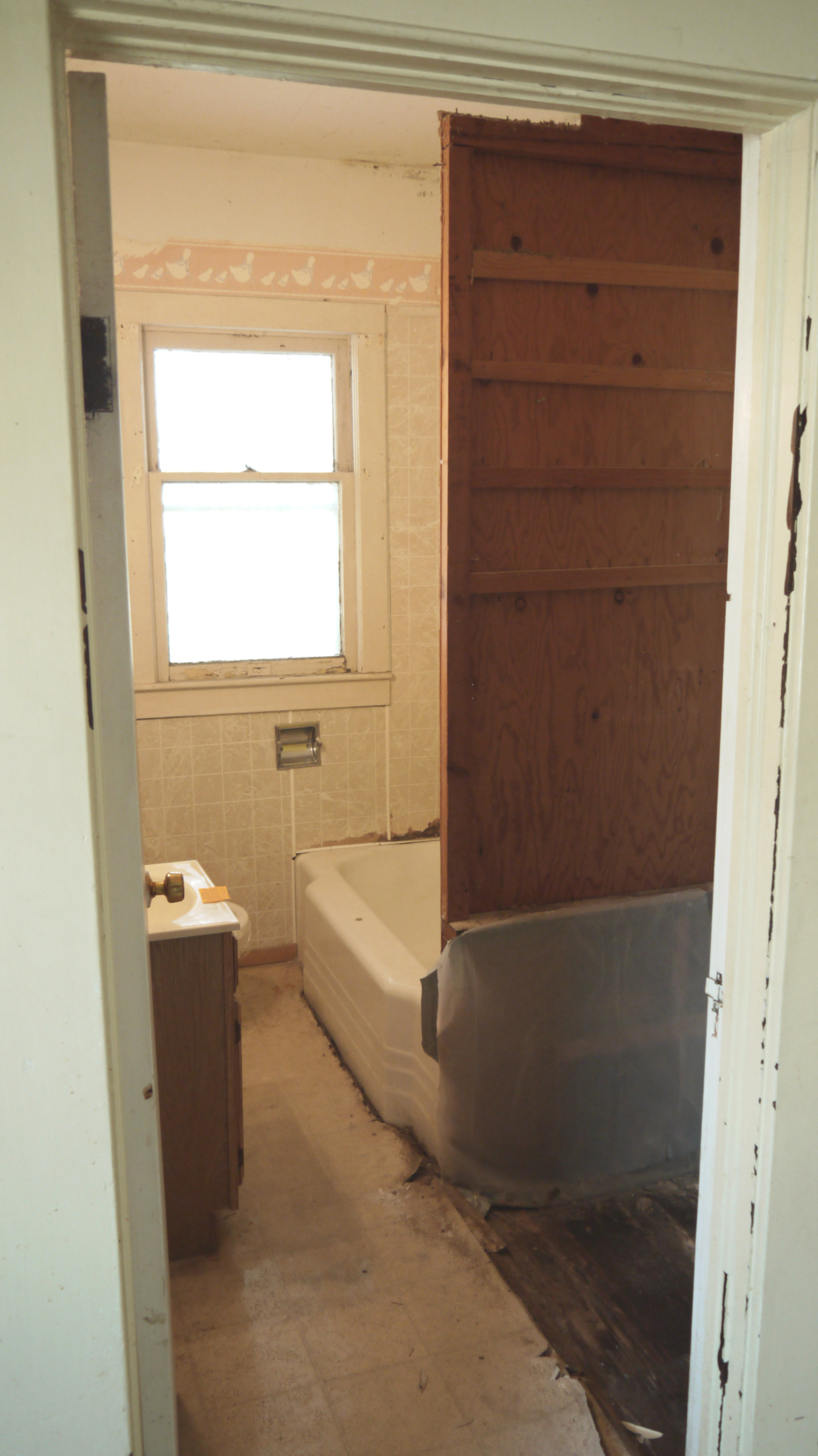
Within just a few hours work, the bathroom was almost empty. I tried to loosen the bolts “holding” the toilet to the floor, but they were seriously rusted tight. So I tried to see how loose it might be to get a saw blade underneath to cut the bolts, and I nearly picked it right up off the floor, no kidding! It was only held on one side, and barely at that. The sink vanity, although not in bad shape (I plan to put it by the curb with a “FREE” sign) literally felt like a child’s sink in height. I can only imagine the neck and back pains trying to wash my hands or brush my teeth in that, not exactly chiropractor approved for my 6′-4″ tall self.
The flimsy paneling wasn’t glued at all, just a few nails into the plaster so it ripped off so quick. And then I started ripping up the flooring. I didn’t take photos of every layer, so let me describe it: imagine a sandwich of linoleum, 1/2″ thick plywood, linoleum, strangely soft and termite eaten panel board, and then another layer of linoleum on top of the home’s original wood floor. Each layer showed signs of being glued at one time, but thanks to the amount of water it survived and what looks like hungry termites, they simply peeled off like a freshly baked Pillsbury grands biscuit. Hungry? Me neither.
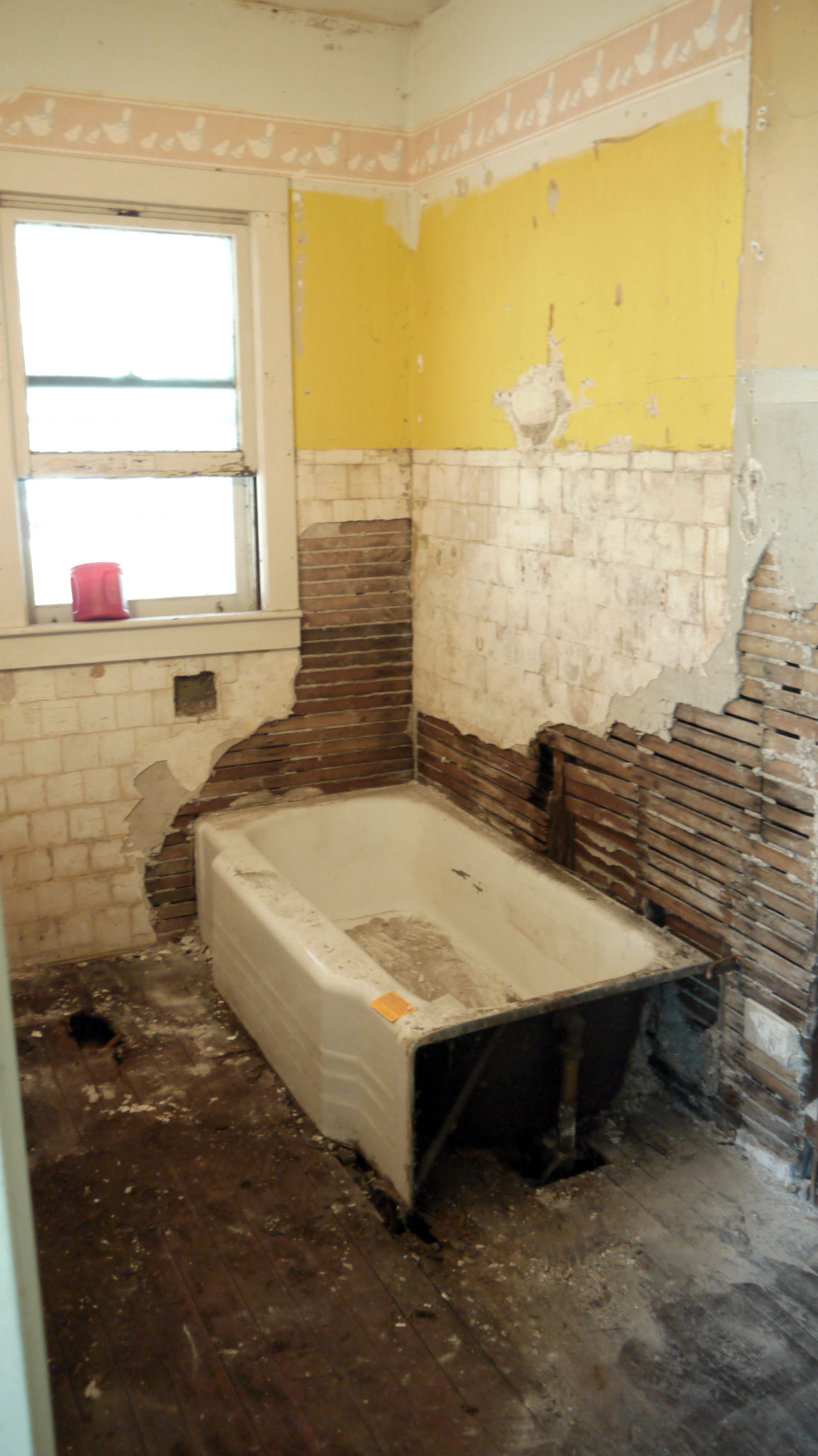
At first, I was super excited to see the wood floor peak out under all those layers of wet flooring. But the closer I got to the tub and toilet stack, the worse the wood got. Until eventually, I put accidentally put my foot right through the spot where the toilet bowl would have been. It just splintered apart. And the board broken at the front edge of the tub was rotted through, it came up like ripping apart a dry sponge. And trying not to fall through the floor was the cruelest game of hop-scotch.
I debated about whether or not to remove the tub. My debate lasted all but 10 seconds. The tub drain had signs of leaking, with every connection corroded. But I have never moved a cast iron tub before. Thank goodness for friends who are willing to come over and help lift a tub. Seriously, thanks Kyle!
Next came knocking down the loose plaster. I didn’t think this step through. I figured knock down what was loose, then take out the floor. Looking back, I should have simply cut out all the plaster and lath for the entire wall behind the tub and on the toilet wall right then. For the window wall, I don’t want the insulation to fall out, and I don’t plan to run any pipes or wires through that wall, so that lath can stay.
So now the tub is sitting in my kitchen, where a normal person would have a stove and refrigerator. But I am not a normal person, so I have a tub in mine. I love the look of the enameled cast iron, and it’s really very solid. I expect it to clean up really well with a ton of elbow grease after I get it reinstalled.
Where I left it on Saturday was beginning to cut out the wood floor. Yes, cried a little at this step, knowing how nice a dark and luxurious wood floor would be beautiful in an otherwise classic black and white tile bathroom. But the amount of rotted wood was just too much, the entire half of the room closest to the window would have needed replaced. I would have found boards to match, and by cutting out the floor I gain a larger access into the crawlspace for when its time to run new plumbing and add new electrical lines to a few other rooms. So attack it I did with the Sawzall, and there’s no looking back now. Plus, many homes of this age originally had marble or hex-tile bath floors, so my finished look should pass as age appropriate.
So what is getting me through the panic attack of not having a bathroom floor at the moment? Below is my bathroom inspiration:

White, lots of white. Except imagine a dark wood medicine cabinet built into the wall, as well as dark wood trim and door. I’m not too much a fan of painted woodwork (yes, this house will be the real test of my paint stripping abilities), and I think a black and white bathroom with just a little bit of deeply stained wood will make the room feel very rich. But in the mean time, I have got some major crawlspace work to do!
 Up and Adam [Ries]