Archive for category Interior Design
The Royal Treatment
Posted by Adam A. Ries in Home Improvement, Interior Design on May 28, 2015
As in, making & installing crown molding in the bathroom. Neither our local lumberyard or even the home improvement stores carried the shape & size of crown molding I wanted. I wanted a large but simple cove shape. No fancy ripples, extra lines, or fake classical over-stylization. No outward bow, no fuss, no fancy. Just a cove. Just like this:
 Sure, I could order it, but at special order price? Heck no. So my brain reminds me that in shop class way back in high school our instructor told us that table saws can be set-up to run the board at an angle to the blade, creating a cove. So I went to YouTube to find some tutorials.
This video was my favorite, it was less guess & check and more technical to get the right angle to get the exact cove I want.
It basically consisted of clamping a long fence at an angle to the blade, and tightening a featherboard on the opposite side to keep the piece tight against the fence. Then let her rip! It took several passes on each board, starting by just shaving off a hair the first pass, and slowly raising the blade each time. The trick was keeping the board pushed down on top of the blade, as they kept wanting to raise. In total it took about an hour to cut the cove on 4 boards. And the pile of sawdust was pretty impressive. After cutting the cove, I cut a 45 degree miter off both the top and bottom edges of each side, so that the board would sit up against the corner of the ceiling & wall. I really didn’t take any photos of this step, it was pretty dusty.
I needed just about 36 feet for the entire perimeter of the bathroom, so I simply used 1″ x 4″ pine boards. Although I stripped the paint and re-stained the woodwork around the door & window, I knew from the get-go that the crown would be painted white. I want it to feel like part of the ceiling.
Even by running the boards a second time across the blade without raising it, each board still had kerf marks along the entire length of the cove. This meant first scraping the cove with a metal scraper, and then lots and lots of sanding. I actually wrapped sandpaper around a short length of 3″ PVC pipe to sand the cove, and then sanded the mitered edges too.
A coat of primer and 2 careful coats of Sherwin Williams Pro-Classic (supposed to be the best latex enamel on the market, drying to a hard finish recommended for trim and cabinetry). I also added a measured amount of Floetrol to the paint. Floetrol is a paint additive designed to slow the drying time to make sure the paint levels as it dries. This helps eliminate any brush or roller marks. The results were worth all the work – they looked like factory finish trim boards!

Then measure, mark, measure, and cut. And then cut again, because with crown molding I always forget that by holding the board up against the miter saw fence it is upside down. So it’s a mental game to get it just right. Luckily I only made the wrong angle cut twice, each on the first end of a board and not when the measurement had to be exact. One wrong cut and it’s very easy to be stuck with a piece 2″ too short.

The first few walls were pretty simple. The corners seemed to line up alright, and the walls were pretty flat.
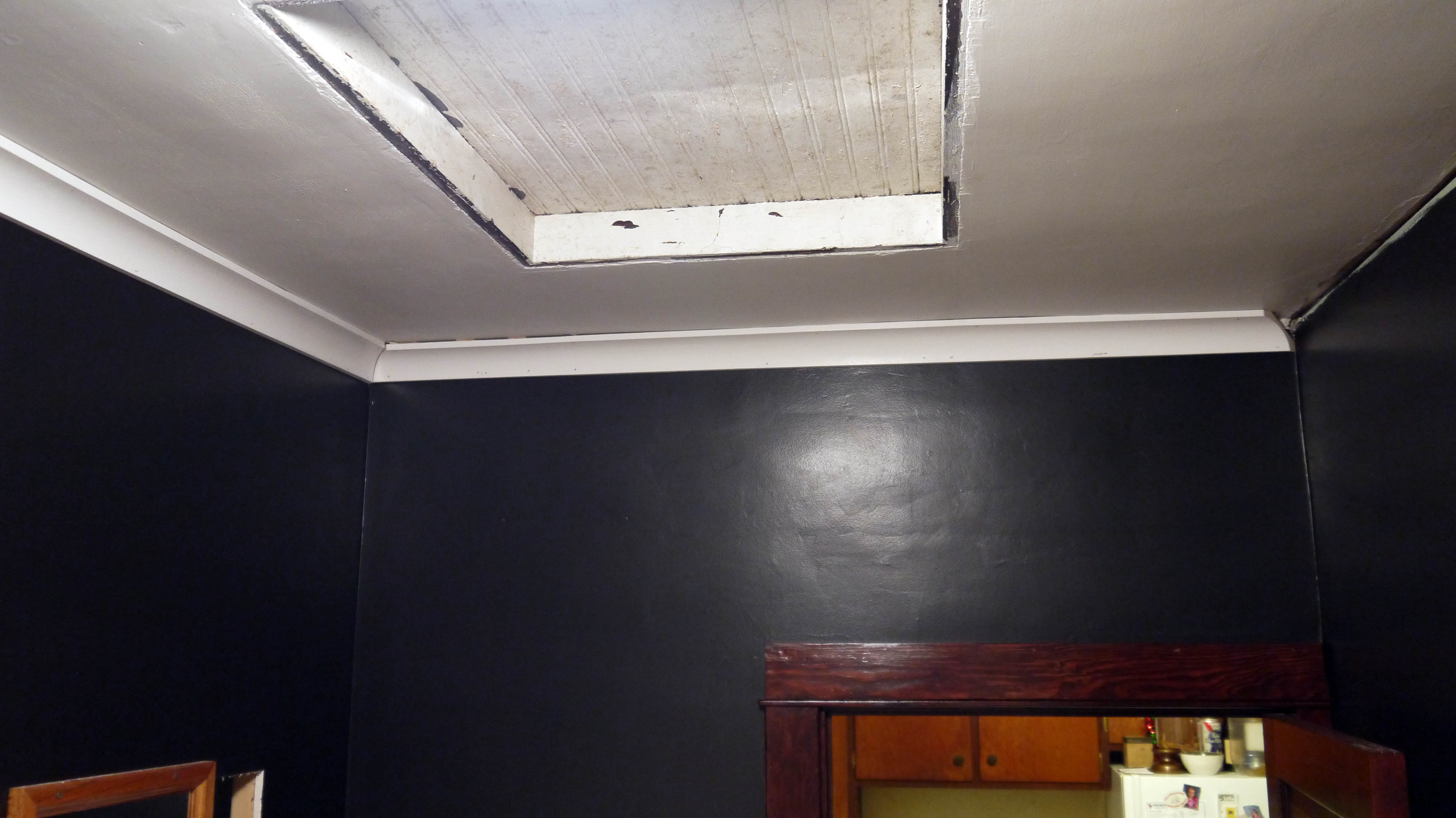
Then came the corner of the South wall, where I kept the original plaster. Apparently it is not an exact 90 degree angle. No surprise there though. And lots of nail holes to try to get the cove molding as tight as possible to both the ceiling and wall.

Once all the pieces were hung, then came filling every nail hole, corner, and seam along the ceiling with white paintable caulk. I put the priority on getting the trim tight to the wall, and it worked pretty well. This way I could use caulk in the seam where it meets the ceiling to fill any gaps and not have to do this along the black paint.
I still have to go back for touch-up painting the spots where I caulked, but I’m thrilled with how it turned out. It looks much more elevated than any other room in the house. A touch of class in a classic bathroom. And then the ugly attic access. Eventually that will be painted the same enamel white along with the narrow trim around it, and won’t be such an eyesore in the middle of the ceiling.

Finding my Niche
Posted by Adam A. Ries in DIY, Home Improvement, Interior Design on September 3, 2014
I love the look of white and gray Carrara marble, especially the aged floors and walls one can find in period homes and old buildings. It’s a rather soft stone, so it shows wear after decades of use. But that wear adds to its beauty.
Unfortunately, I really couldn’t afford marble for my bathroom. There is just too much tile on the walls, and even the floor would have been too expensive in marble hexagon mosaic. I just couldn’t justify investing that much into this modest of a home – a humble 2-bedroom house in this neighborhood won’t see that return on re-sale anytime soon.
But I found a way to get my beloved marble after all – and affordably.
When it came to tiling the built-in niche, I used the mini-subway tiles (2″ x 3″) for the back wall, and I planned to use bullnose edge tiles for the sides to wrap back to the shower wall. But I didn’t like how the bullnose tiles looked on the bottom ledge. Knowing that soap bars and bottles would be sitting here wet, that would have meant constantly dirty grout lines. Not to mention, I’m not sure how I would make a shelf in the middle using smaller tiles – how would it hold itself up?
So while walking through the tile aisle at Home Depot, I saw how affordable 12″ x 12″ marble tiles are – $3.99. And I realized I could get both the bottom ledge and center shelf from a single square.
I cut and installed the bottom ledge first, and I liked how it looked to keep it slightly proud – 1/8″ or so – of the surrounding wall tiles. It gives it more pronunciation, and that “I designed it like this on purpose” look. To make sure it drains, I pressed it into the fresh thin-set and pressed harder along the front edge – so it is slightly slanted out toward the tub.

For the sides, I used a bullnose tile. Because the niche is 4″ deep, the 3″ bullnose tile wasnt deep enough. I had to use 4″ bullnose tiles, so up and down both sides I had to cut each tile so that the grout lines would line up. I went 4 tiles high -the equivalent of 12 inches- then set the next marble piece in to act as the upper shelf. It sits on the tiles below it.
Where the top and sides meet, I cut the meeting edge at a 45 degree angle to miter the corners. The resulting niche is below.
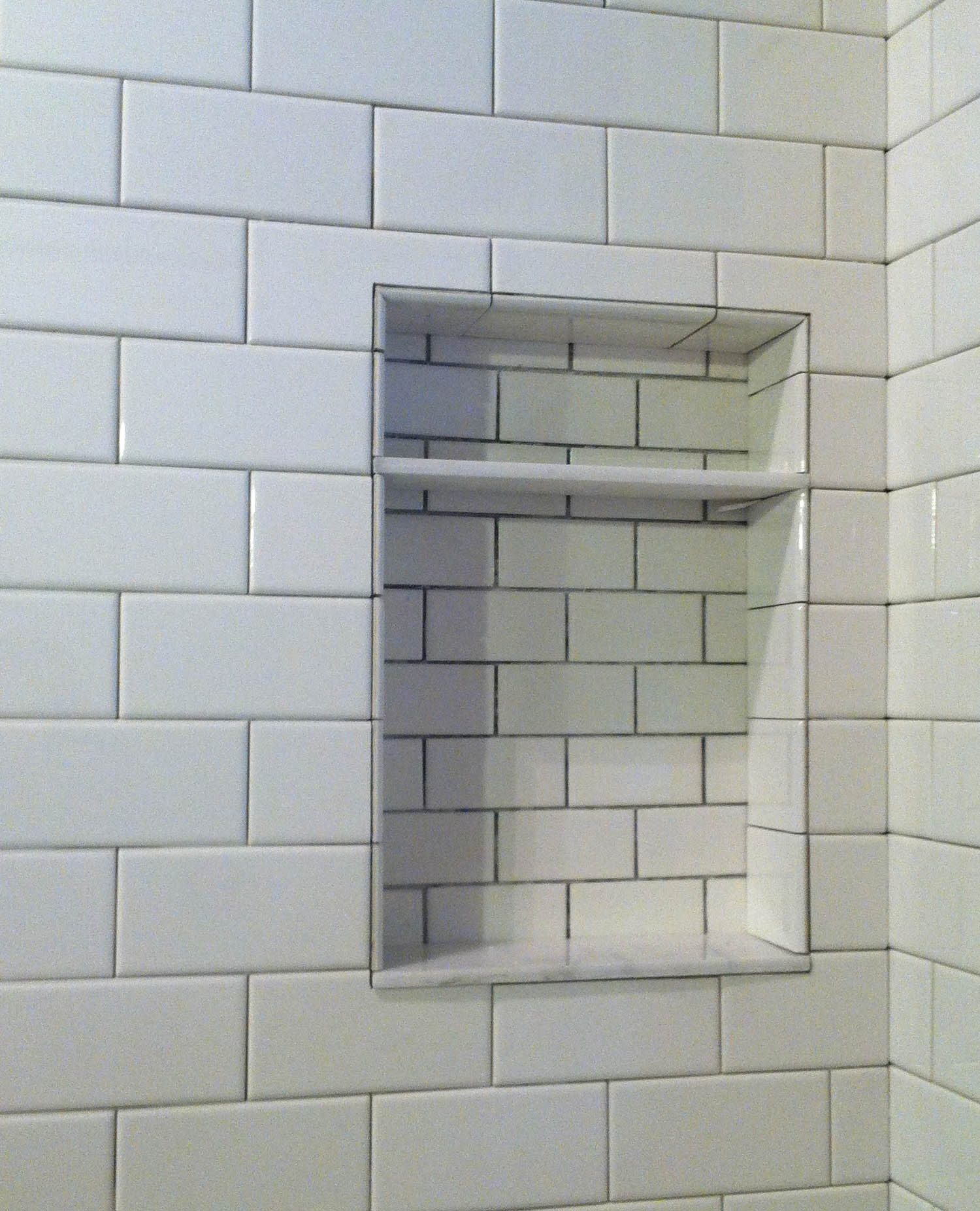
The marble looks great, just a hint of natural stone in the field of all white ceramic tile. Both the ledge and shelf are just slightly pitched to drain outward, so water will drain. The only thing I realized afterward is that the factory edge of the marble isn’t exactly smooth. In fact, it’s almost sharp. Not “cut off a finger” sharp, but “ouch,” noticeably sharper than it should be. I’m thinking I will try to hone it down with wet-sandpaper and see what that does.
Grouting this was a little tricky also. The tile float was almost too big, especially in the upper part. But the beauty of grout is that messy doesn’t matter, it all sponges off.
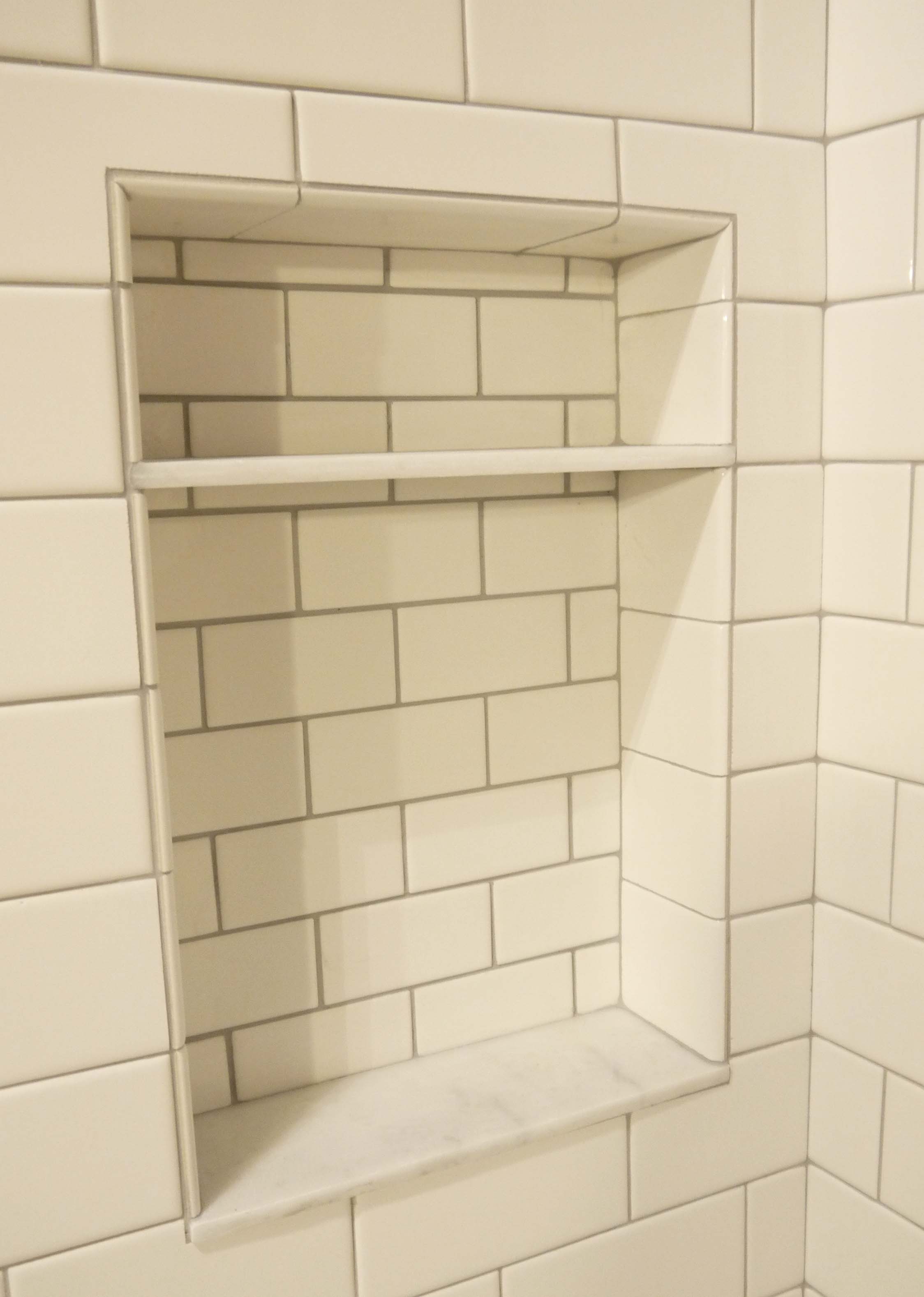
I’m thrilled with how it looks! Not a huge amount of shampoo storage, but enough for 5 or 6 bottles lined up sideways, and a few bars of soap on the shelf above.
The window ledge and sides will be done very similarly, only I’m planning to use a piece of marble threshold for the ledge. Lowe’s sells them in different widths and lengths, so I can find one to fit and not have any seams along the sill. But I have another week yet until the window arrives. In the mean time, I’m working on getting the wood dresser transformed into the bathroom vanity. Check out how it looks so far:

One Month Later
Posted by Adam A. Ries in DIY, Home Improvement, Interior Design on September 1, 2014
It turns out tiling takes forever. Or at least a full month for me. Part of the reason is that I’ve traveled to visit friends on my weekends or helped on house projects with family members. The majority of the tiling I had left required using the deathly loud wet saw, and I feel terrible cranking that thing up later than 7 o’clock at night – it is seriously the loudest piece of equipment I’ve ever used, all wrapped up in a table-top saw. I decided to spare my neighbors the screaming from the wet saw, and in turn the tiling wasn’t getting done. Here is how it looked at the last post:

The walls were nearly all tiled, just the trim pieces missing along the top, and of course that pesky wall niche. But more on that later, as I couldn’t make up my mind how I wanted to trim it out.

So it was time for the floor. I sketched out a pattern for the floor that I thought would complement the walls. I knew I wanted white hexagon tile, but I liked how many of the period bathrooms I saw had a black border around the edge, either in black hexagons, little stars, or a solid stripe. In the name on consistency, I used the same narrow black lines that I used on the walls, only a single black line rather than a double.
I started with a 6″ square all around the room and flat up against the tub, then the skinny black liner tile, and then filled in the center – about 5 ft x 5 ft – with the white hex.

While the border pieces went down 1 at a time, I thought the center field would be faster because the hex comes in 12″ sheets with the tiles glued to a mesh backing. But once again I made it more difficult on myself in an effort to ensure the final result looked like a professional installation. In my weeks spent searching inspiration photos on Pinterest and Google, I’ve come across too many bathrooms where intentions were great – but execution was less than impressive. Below is just one example – notice that line where each sheet starts and ends? I vowed not to let that happen.
So my solution was to cut the first sheet of every 2nd row in half and lay the sheets across the floor the way one might lay brick – in a running bond pattern. And although the tiles are glued to a mesh, the spacing between the tiles still wants to vary. It took constant eyeballing the lines and watching for any spacing that looked too thin or too wide. And I still used a ton of 1/8″ plastic spacers.

By this point, I was nearly as far as I could go using full sheets. This last row by the doorway I cut and laid 2 rows at a time, and then it was down to the little fillers around the border. These pieces – each one just a little smaller or larger than the one beside it. What a pain in the ass:

Seriously – the worst part of the whole tiling job right there. Other spots were tricky, but in a good way – like a “DIY Show Off” challenge, like these chair-rail returns:
![P1030849 B]](https://humblebungalow.com/wp-content/uploads/2014/09/p1030849-b.jpg)
But those tiny slivers to finish the floor? Pretty sure every other finger has been cut trying to push those tiny pieces through the wet saw. I was glad when the floor was finished. Speaking of injury, this tiling project has been cruel. Cut hands and fingers on sharp tile edges; tiny little tile chips from the wet saw stick to my arms, but don’t try to brush them off – more cuts like little slivers of glass; like dozens of little paper cuts!
And then there are my knees. By the time I finished, I wish I had invested in a quality pair of knee pads. Lesson learned for the next flooring project. Check out those hexagons!

But in the end, the result was worth all the blood, sore finger tips, and smashed knees. As my neighbors described it over the weekend when they stopped by for a progress tour, “it looks like a charming historic hotel bathroom!” My goal all along has been something that looks “timeless.” I want anyone who sees it to wonder if it’s the home’s original bathroom. By the way, I have some awesome neighbors who are super friendly and invite me over for homemade ice cream… #homebuyingscore.

 Up and Adam [Ries]