Seeing Portabello
Posted by Adam A. Ries in DIY, Exterior, Home Improvement on August 16, 2011
Yes, for the past two weekends we have been seeing and smelling portabello. And getting it all over our hands, faces, and even in our hair. No, I’m not talking mushrooms.

I’m talking paint. As in, Sherwin-Williams Portabello 6102. Don’t let this small color swatch fool you, it looks so much richer in real life, almost like the underneath side of that mushroom above. It really is a very saturated and beautiful golden-reddish-brown color. Catch up to speed on our big house painting adventure planning and how we debated paint colors at this post over here, or see the abbreviated version of the color scheme and a rendering of the finished house by clicking on this post.

Onto the good stuff. We were fully geared up and prepared to paint the house with 2 brushes in each hand. And that is exactly how we primed the entire exterior with Zinsser Peel Stop clear binding sealer. It was like painting with milk; very thin and watery, and dried to a very slight sheen over the surface of the shingles. We wondered if it was even doing any good until we had to clean a few dried drips off of a window frame. Oh my goodness was it nearly impossible to clean off once dry! So if it stuck that well to new shiny vinyl window frames, I figure it must have been a good product!
But after priming, I was not at all interested in repeating that brushing torture once again with the paint. So I began asking around and doing some research on airless paint sprayers. It turns out they are pretty affordable to rent and seemingly easy to learn to use. In fact, this YouTube video is the clip that made me say out loud, “that’s it, we’re renting a sprayer!”
The man in the video is painting the same style and size shingles as my house (pretty much the same ‘before’ color, too) and boy does it go super quick! So just like the video, we masked off all the windows and doors with masking tape and painter’s plastic. We propped up cardboard under the last row of shingles to cover the foundation, and I held a piece of cardboard attached to a handle as a long blade against the soffit above the top row of shingles. And then it was time to spray.
I first used water to familiarize myself with the airless sprayer. I ‘painted’ water onto a large piece of cardboard so I could see how thin and even of a spray the machine produced. By spraying in about 3 – 4 foot lengths and overlapping each path by half, I got the hang of it really quick. So I primed the sprayer with paint and gave myself one more test run on the cardboard. Time to hit the house. I don’t know why I was so hesitant, the paint sprayed out so thin and evenly, filling all of the grooves in the cedar shingles effortlessly. By overlapping each length of spray, I was left with a smooth finish and a solid cover of paint. No need for two coats!

Check out the white primer polka dots, no? You have no idea how glad I was to paint over them and rid the house of its primer pox epidemic. And now for a close up comparison of the ‘before’ and ‘after’ colors for you to eat up (yes, that was a pun on the paint color name).
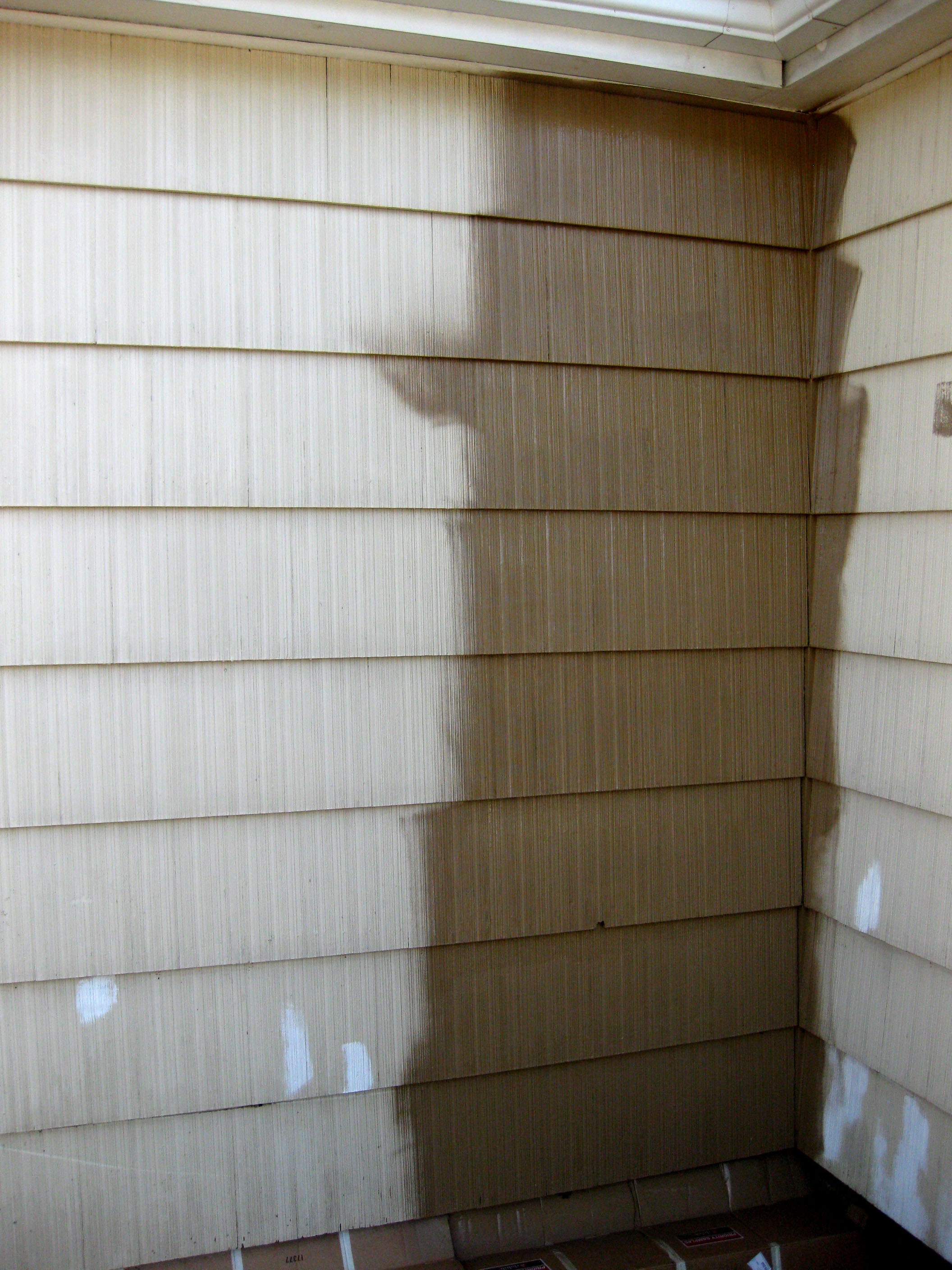
The only caution I would give, and I was fairly warned by the managers at the Sherwin-Williams store, is to be prepared to back-roll (or in my case, back brush) the paint after spraying a large section. Anywhere that I overlapped more than a half stripe or even sprayed a second coat would begin to run and form drips. These areas just need a once-over with a paint brush, hence the term back brushing, to even out the spray.
I actually painted the house in 2 Saturdays, partly because I started later in the day (masking off windows takes for-ev-er) and partly because I ran out of paint on the first Saturday too late in the day to run out and get more. But after it was all painted (even before it was completely finished), I was ecstatic with how it looked! I am in love with the deep rich color, and so pleased with how well the paint covered. We painted with Sherwin-Williams Duration Exterior Acrylic Latex , known for its superior color coverage and long lasting paint performance.
So how far have we come? Here is the original before photo, house circa summer 2009; aka, boring beige (although it has a slight pink tinge in that particular photo).
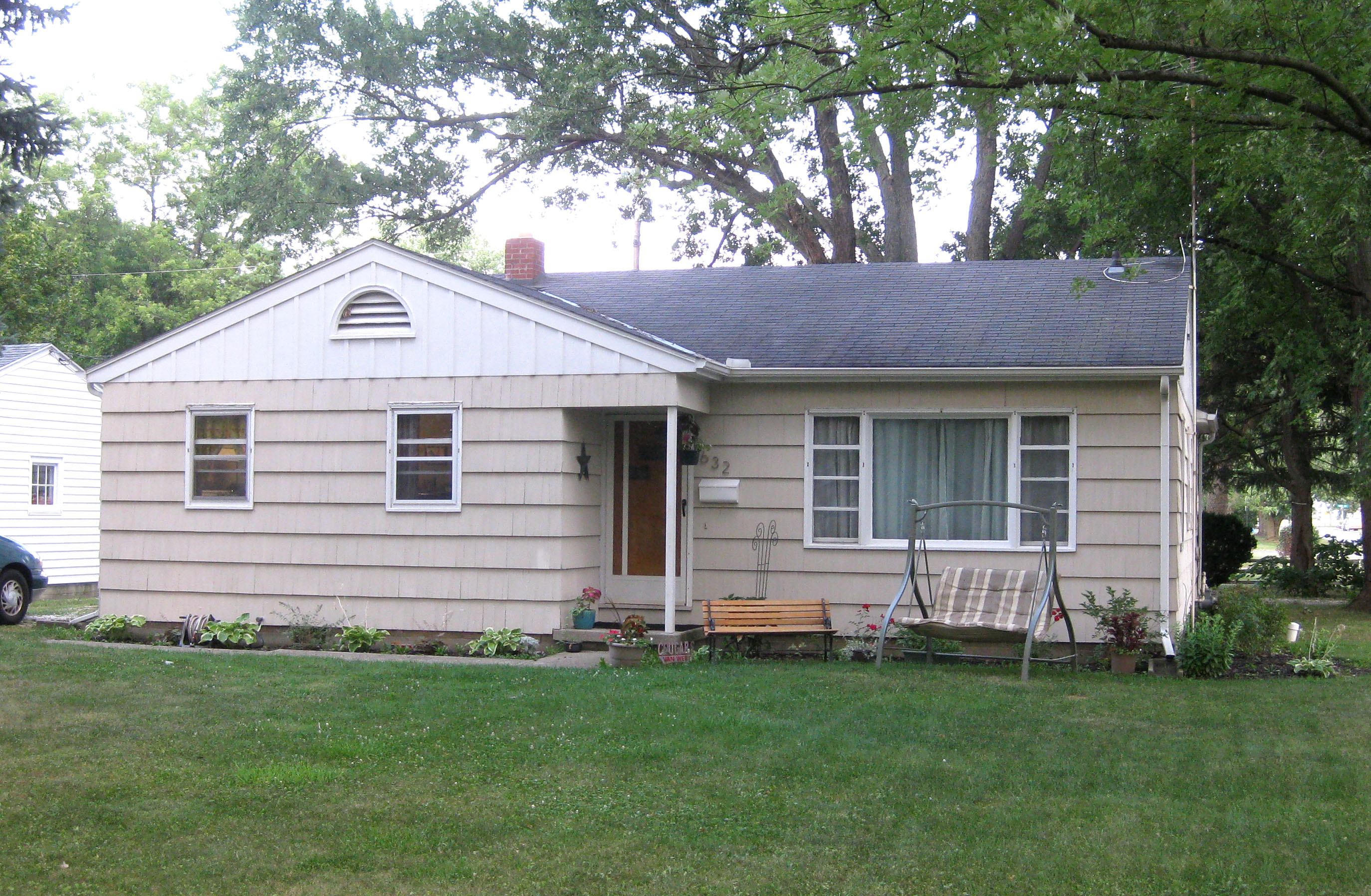
Here is the house before we painted. Yes, it is looking a little poka-dotted or zebra striped or something in between as a result of different color shingles around the windows, tinted primer under the picture window, and tons of primed areas around the single windows. As people would walk through the neighborhood in the evenings, you could see them point and look, and looooook. Probably wondering what in the world we were doing. At least the sky is beautiful in this photo.

And here is the house after a super rich paint job of Portabello. I was going to say what percentage of an improvement the new paint is, but the actual number is off my scale. Probably something like a mbajeelion (silent m) times better looking. (Click here to see how closely this real photograph compares to a rendered image I created at the beginning of this painting project).
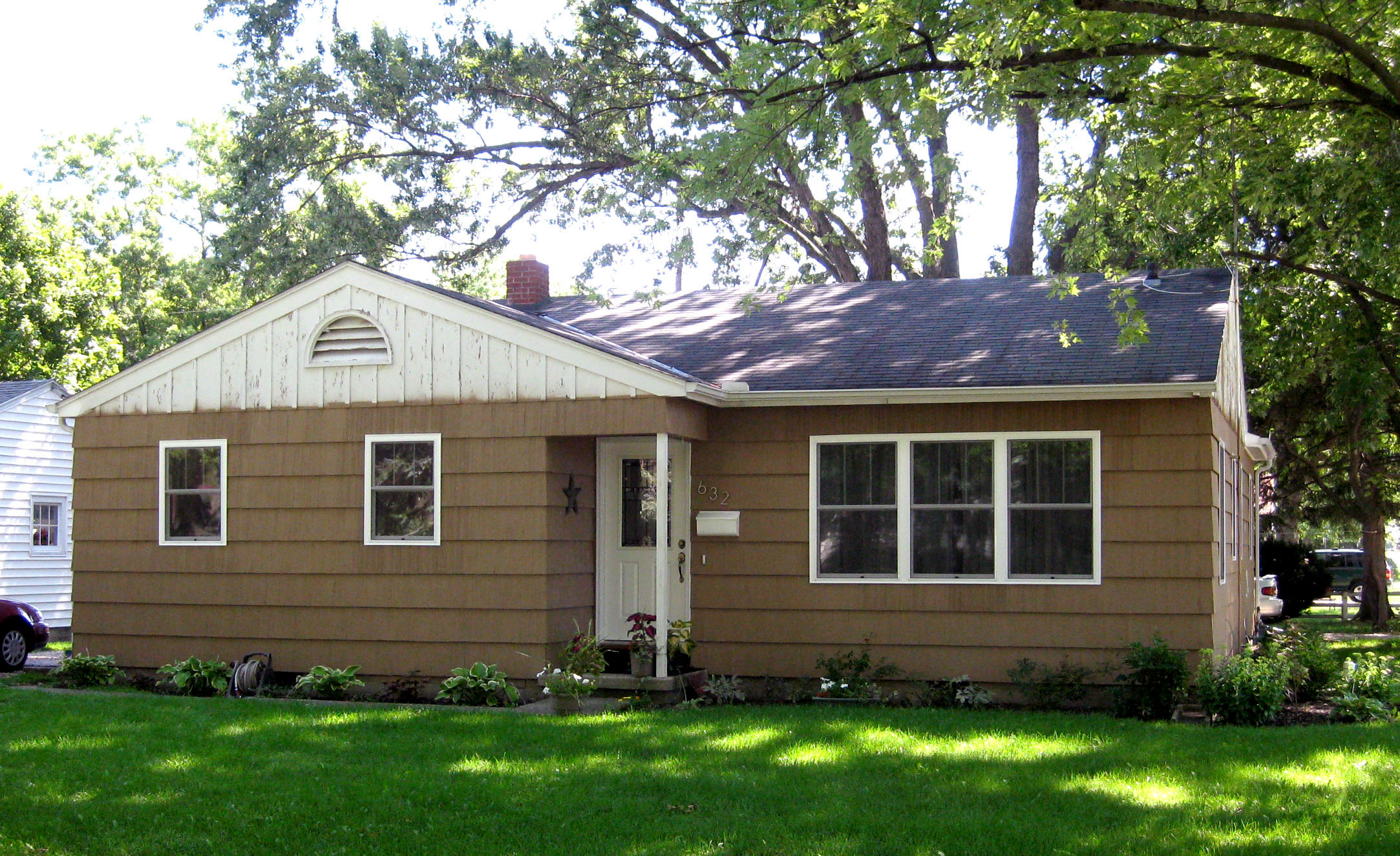
Improvement? I think so. I am still in the process of painting the fascia boards and soffits bright white, and then will be painting the gables. All by hand, brush and roller. I decided that with the amount of overspray produced by the airless sprayer, it would be nearly impossible to spray the gables and have a clean crisp painted edge when done without using 20 miles of painter’s tape. Which isn’t cheap, by the way. So up and down a ladder with a paintbrush in hand I will go. And hopefully I will finish before the snow flies.
Magic Playdough and All Lit Up
Posted by Adam A. Ries in DIY, Exterior, Home Improvement on July 28, 2011
Ok, so it wasn’t actually playdough. But it looked just like it, felt just like it, and I may have sculpted a dinosaur before using it for its intended use. So what in the world am I talking about?
It all began when I removed an old exterior floodlight. The light was intended to illuminate the walk between the house and the detached garage. It was attached to the end of a length of fascia board in the back of the house. The light was also ancient; it was heavy, had 3 heads, exposed wire connections, and didn’t even work. One bulb was missing, one was broken, and the other didn’t work. It was an eyesore. And I am embarrassed to say that I didn’t do anything about it for the past 2 years.
Well, this past weekend I went about scraping the trim and gable on the back side of the house. This meant finally removing this dark (pun intended) blemish once and for all. I just capped the wires once I detached them from the light, and began to unscrew the fixture from the fascia board. I should have been wary as the screws came out of the fascia board a bit too easily. Sure enough, the old light fixture was a water trap and the end of the fascia board was badly rotten. Far to rotten to just paint over. But that one board was almost 18′ long along the length of the gable, from the end where the light was attached up to the peek. And there was no way I wanted to remove and replace that entire 8″ wide board.
Confession: I failed again at the idea of taking a “before” picture. I am too much of a doer that I often forget to document each step. So this photo of some other home’s damaged fascia board will have to serve as a “before” picture. Just ignore the brick.

After consulting with an expert carpenter, aka my grandfather, I went in search of a product he knew existed but had never used himself before. Some sort of super hard-drying wood putty made just for repairing rotted wood. Sure enough, the home store had it! I bought a large enough kit to repair not only this area, but any others I might find before this painting (scraping, sanding, washing, brushing, priming, ladder-climbing) project is over.
 It turns out it is an epoxy hardener. The kit I bought had two ingredients and came with plastic gloves and a plastic scraper. The instructions said to mix an equal 1:1 ratio of the filler putty and hardener putty in your hands (while wearing gloves), or knead together on a non-stick surface. I used a small putty knife to spoon out equal amounts of each putty, about a golf ball size of each, and began mixing them like playdough in my hands. I wore latex gloves like the instuctions said, but I could still see the two different colors weren’t entirely mixed yet. So I began to knead the putty on a piece of glass, almost the way a baker would knead bread dough. This seemed to mix the putty quite well, as it became a solid yellow/beige color. The instructions said your working time with the putty after mixing is only about 10 minutes, so I began right away. I had already used a wire brush on the rotted fascia end to remove all the loose wood chips, peeling paint, and earlier attempts at repair with silicone. I applied the epoxy mixture first with a putty knife, but it was too difficult to smooth out. The box said you could increase the working time by lightly dampening with water. So I filled a plastic pail and dipped my fingers in water to smooth out the epoxy on the end of the board. I got the putty as smooth as I could, and used the putty knife to create a sharp corner and end to resemble as closely as possible the original shape of the board. Then I waited.
The box said ready to sand in 60 minutes. I got busy painting some other area and forgot about the putty for a few hours. When I returned to the spot, it was hard as rock! I broke out my old school sanding block and tried to get the spot perfectly smooth, but it was tough to sand. It actually started to shred my sandpaper before it created any dust. Good thing I mostly got it smooth before it was dry.
For this step I did snap a photo. The yellow patches near the gutter are the epoxy putty drying. Just like the box promised, the putty did not shrink or crack while it dried. Those two capped wires are the house wires which originally powered the old fixture, probably 50 years ago.

I primed the spot, and brushed on 2 coats of super brilliant white paint. The next day I went about putting up the new light fixture.
This is the light fixture we chose from the home store. I wanted something white to blend in with the white trim board, but something fairly petit looking. Security floodlights often look huge and alien in shape with their multi-directional cone heads. I liked this one because it felt simple and compact, but would still be powerful enough to light the small space between the house and garage. It’s 150 watts and an Energy Star Qualified product; it’s motion sensor doesn’t turn the light on during the daylight hours.

It was super easy to put up. I marked the spot for the outside junction box with a light pencil line and drilled two pilot holes for the screws. I ran a thick bead of paintable caulking in a circle behind the junction box and screwed it tightly into place. After wiping away the excess squeeze out of caulking, I plugged all but one of the outlets with the included plastic plugs. I ran the electrical wires from the house through the remaining outlet opening and began to twist them together with the wires from the new light fixture. Twist black wire with black wire, white wire with white wire, and attach the ground wire from the new light around the green screw of the junction box. Put the foam seal in place between the new fixture and the junction box and tighten into place.
How does it look? Compact and simple, not too flashy (once again, pun intended). Pay no attention to that new paint color on the house shingles… post coming soon about that!
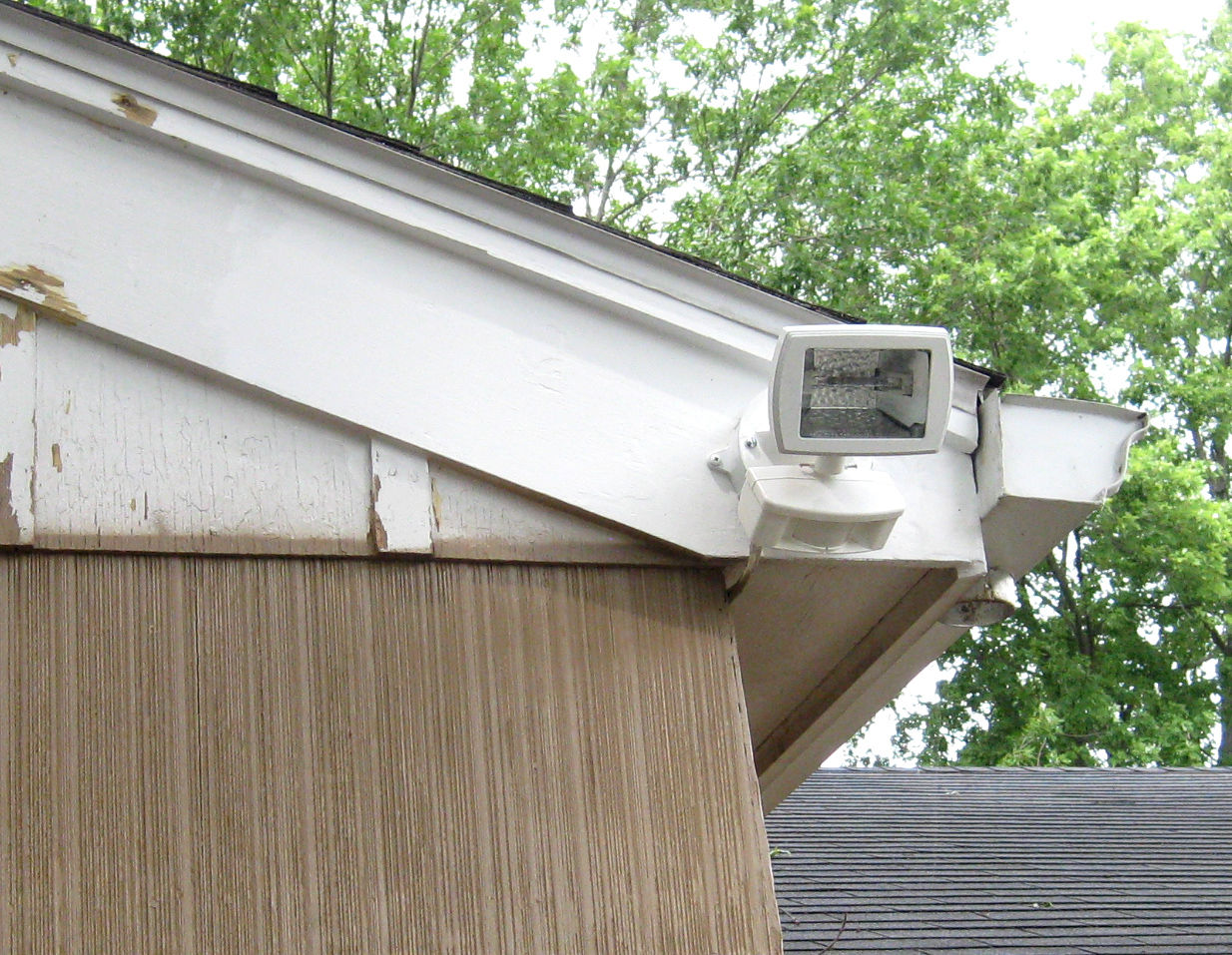
When I turned the power on, bing! The new halogen light came on super bright, all 150 watts. It can be set for 4 minutes, 12 minutes, all night, or all day and night. We are going to use the 4 minute setting. That way if I pull into the driveway at night, I have plenty of light to find my way to the back door, balancing the bag of groceries and gallon of milk, dig the keys out of my pocket and get into the house safely. And then the light turns itself off automatically. Not that we live in sketchy neighborhood (actually, its a very quiet and safe neighborhood comprised mostly of senior citizen homeowners), but I definitely prefer to walk from my car to the house at night with a light on. Here is a photo of it at night, plenty bright enough!

So the first night. The roaming cats must have been having a dance party in the backyard. Pretty sure that light was blinking on and off all night. Hopefully the neighbors will understand we are adjusting the sensitivity of the motion detector… I didn’t realize I had it on high sensitivity the first night. After that, I turned it down to about half way and it seems to be working all right. The squirrels and other suburban backyard creatures don’t trip the sensor, but if I walk to the garage after dark, I have plenty of light to find my way (a whopping 20 steps) without having to worry about turning a light on or off. Success.
All That Glass
Posted by Adam A. Ries in Other on July 19, 2011
My window replacing adventure took several months, and as each new window was installed the old window from the house took its place in the garage. So once all the new windows were snuggled tightly into the walls, the old windows were a dusty heap in my garage, taking up valuable space which I like to use for refinishing/repairing furniture. I blogged in this post a while back about a company just an hour away from Van Wert that actually recycles all types of glass, including window glass. The grand plan was to disassemble the windows, which would not have been difficult because they were nearly falling apart anyways, and haul the glass to Upper Sandusky to be recycled. When the weather hit 90 degrees, I quickly became reluctant to spend my weekends removing the glass in my 200 degree garage. So I posted an ad on Craigslist. And guess what? A guy came and said he wanted all of the windows, storm windows included! It turned out that he is a local artist that likes to paint on glass. He likes to use reclaimed materials, mostly glass and spray paint, and creates awesome looking space and sci-fi artwork. Here are just a few of his more recent pieces of art, gleaned from his Facebook page.
In whole, reusing a material is so many times more sustainable than recycling. The energy used to transport and re-manufacture that material is saved if the product can just be reused another way. So no glass recycling in my future, but all the same, I am thrilled that someone else will get use and enjoyment out of those old windows.
 Up and Adam [Ries]